Welcome!
Live the Faith!
Come Worship with Us!
Come and See!
Explore
St. Francis Xavier Petoskey
(opens in a new tab)This is the official Facebook page for St. Francis Xavier Church in Petoskey, Michigan.
...
0 CommentsComment on Facebook
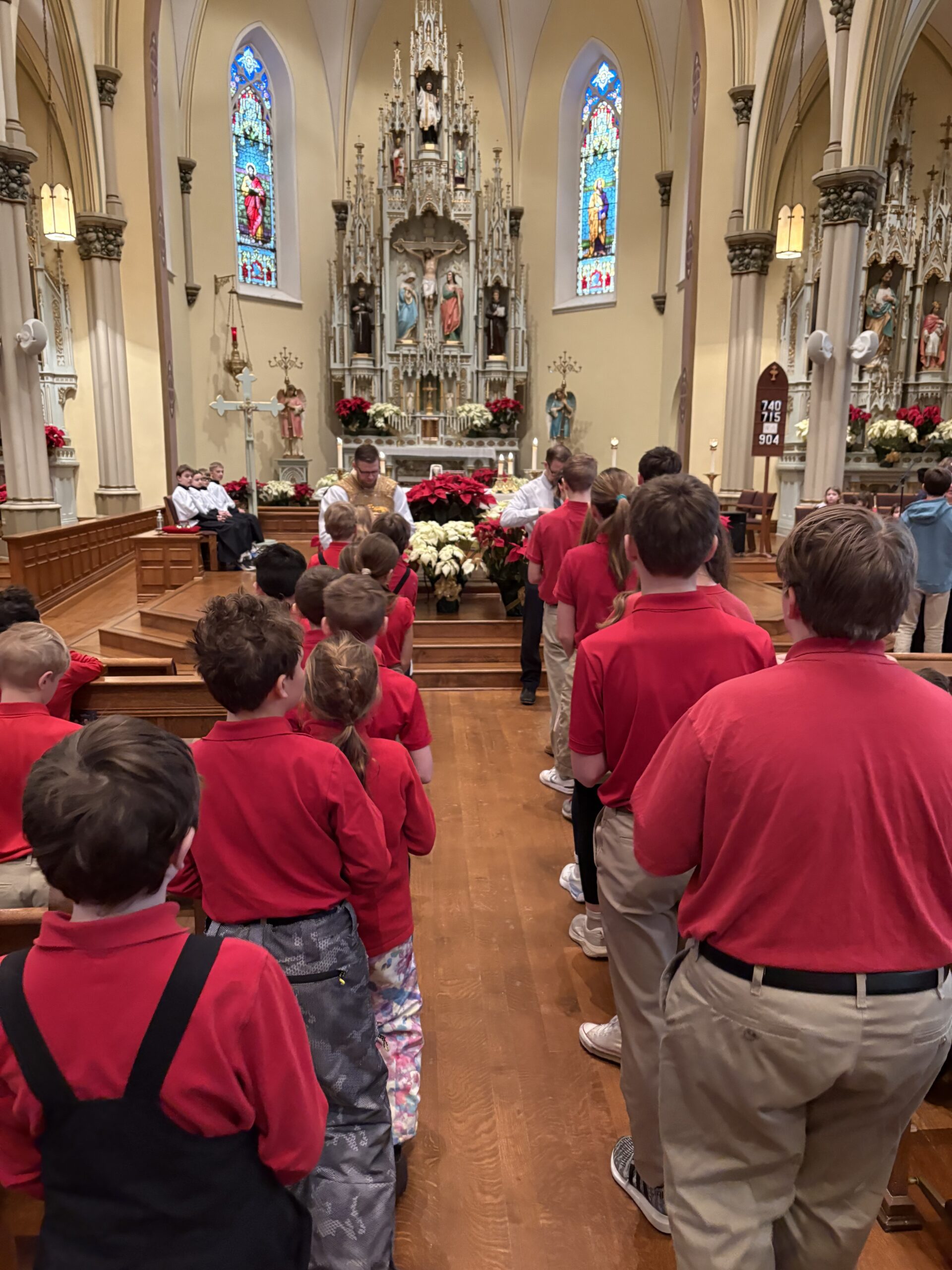
Eucharistic Adoration and Benediction
Dear students,
Today we are going to do something very special: we are going to spend time with Jesus in the Blessed Sacrament.
You may be wondering: Why do we sit quietly in front of a piece of bread?
The answer is very important.
Jesus Is Truly Present
At Mass, during the consecration, something extraordinary happens. The bread and wine become the Body and Blood of Jesus Christ.
Although the Eucharist still looks like bread and wine, Jesus is truly, really, and substantially present—Body, Blood, Soul, and Divinity.
This is why we genuflect when we come into the presence of the Blessed Sacrament. We are not simply showing respect to a piece of bread. We are showing reverence to Jesus.
Jesus said:
“This is my body, which will be given for you.”
—Luke 22:19
And He also said:
“I am the bread of life.”
—John 6:35
The Eucharist is Jesus giving Himself to us.
What Is Eucharistic Adoration?
Adoration means spending time with Jesus.
When the Blessed Sacrament is exposed in the monstrance, we are invited to come before Jesus and simply be with Him.
You don't have to say many prayers.
You don't have to know exactly what to say.
You can simply look at Jesus and say:
“Jesus, I love You.”
Or:
“Jesus, I am here with You.”
Or:
“Jesus, help me.”
You can also sit quietly.
Sometimes the best prayer is simply being present with Jesus.
Think about someone you love. Sometimes you don't need to talk. You are happy just being together.
Adoration is like that.
What Should We Do During Adoration?
When you come into the church or chapel, remember that you are entering the presence of Jesus.
So we should:
Enter quietly.
Genuflect reverently.
Find a place and kneel or sit.
Put away distractions.
Turn off or silence phones.
Speak quietly when necessary.
Allow yourself to become quiet inside.
Then look toward Jesus.
You can tell Him about your family.
Tell Him about your friends.
Tell Him about something that is worrying you.
Tell Him what you are thankful for.
Ask Him to help someone who is sick.
Ask Him to help you become a better student, a better friend, and a better Christian.
And most importantly, listen.
We often spend our prayers talking to God. Adoration gives us an opportunity to become quiet and allow God to speak to our hearts.
What Is Benediction?
At the end of Eucharistic Adoration, the priest gives Benediction.
The word Benediction means blessing.
The Blessed Sacrament is placed in a special vessel called a monstrance. The priest or deacon uses the monstrance to bless the people with Jesus in the Eucharist.
Think about what is happening.
We are not simply receiving a blessing from the priest.
The priest is acting as a minister of the Church, and Christ in the Blessed Sacrament is the one we are adoring.
This is why Benediction is such a beautiful and reverent moment.
When the priest raises the monstrance, we should be quiet and prayerful. We can make the Sign of the Cross as the blessing is given.
Why Does This Matter?
You are living in a very busy world.
There are phones, computers, games, sports, homework, social media, music and many other things competing for your attention.
But Jesus says:
“Come to me.”
Adoration gives us a chance to stop.
To become quiet.
To breathe.
To remember what is most important.
Jesus is here.
And Jesus knows you.
He loves you.
He created you.
He knows your struggles.
He knows your hopes and dreams.
And He wants you to become the person He created you to be.
So when we come before the Blessed Sacrament, don't worry about whether you are praying perfectly.
Just remember:
Jesus is here.
Jesus sees me.
Jesus loves me.
And I am here with Jesus.
That is enough.
Before We Begin
As we begin our time of Eucharistic Adoration, I invite you to make a simple prayer:
“Jesus, I believe that You are truly present in the Blessed Sacrament.
Jesus, I adore You.
Jesus, I love You.
Jesus, thank You for giving Yourself to me.
Help me to know You, love You, and follow You.
Amen.”
Now let us become quiet and spend this time with Jesus
...
1 CommentsComment on Facebook
Job opening
Faith Formation Director
...

0 CommentsComment on Facebook
Job opportunitie
linkprotect.cudasvc.com/url?a=https%3a%2f%2fhcm.paycor.com%2fl%2fr%2f66C61EF5&c=E,1,pXdvb70We845R...
hcm.paycor.com/l/r/ED42FB4D
...
0 CommentsComment on Facebook
26th Sunday in Ordinary Time
In today’s Gospel, Jesus tells us the parable of a father who has two sons. He goes to the first and says, “Son, go out and work in the vineyard today.” The son says, “No,” but later changes his mind and goes. The father asks the second son the same thing. He says, “Yes, sir,” but he does not go.
The vineyard in the Bible is often a symbol of Israel, God’s chosen people. God has entrusted His vineyard to His people and expects them to respond to His call. But Jesus uses this familiar image to speak not only about Israel but also about us.
The question for us is simple: When God says, “Go and work in my vineyard today,” what is our response?
Sometimes we are like the first son. We say “no” to God. We hesitate. We make excuses. Perhaps we think, I am too busy. Someone else can do it. I am not ready. But later, we change our minds and say yes. And that yes matters to God.
At other times, we can be like the second son. We say all the right things. We say, “Yes, Lord.” We come to Mass. We pray. We call ourselves Christians. But when God asks us to serve, forgive, reach out, teach our children the faith, help someone in need, or become more involved in the life of the Church, our “yes” can remain only words.
Jesus reminds us today that God is looking for more than words. He is looking for a response expressed in our lives.
The vineyard is still here. It is the Church, our parish, our families, our community, and the people God places in our path.
Every day, God says to each of us: “Go and work in my vineyard today.”
He may be calling us to volunteer, to serve, to forgive someone, to encourage a struggling family member, to pray for someone, to become more faithful at Mass, or simply to be a witness to Christ in our daily lives.
And perhaps the most beautiful message of the Gospel is that it is never too late to change our answer. The son who first said no eventually went. God gives us the grace to change our hearts and begin again.
So today, let us not ask only, “Did I say yes to God?” Let us ask something deeper:
“Did I live my yes
...
0 CommentsComment on Facebook
Teach us to give and not count the cost.